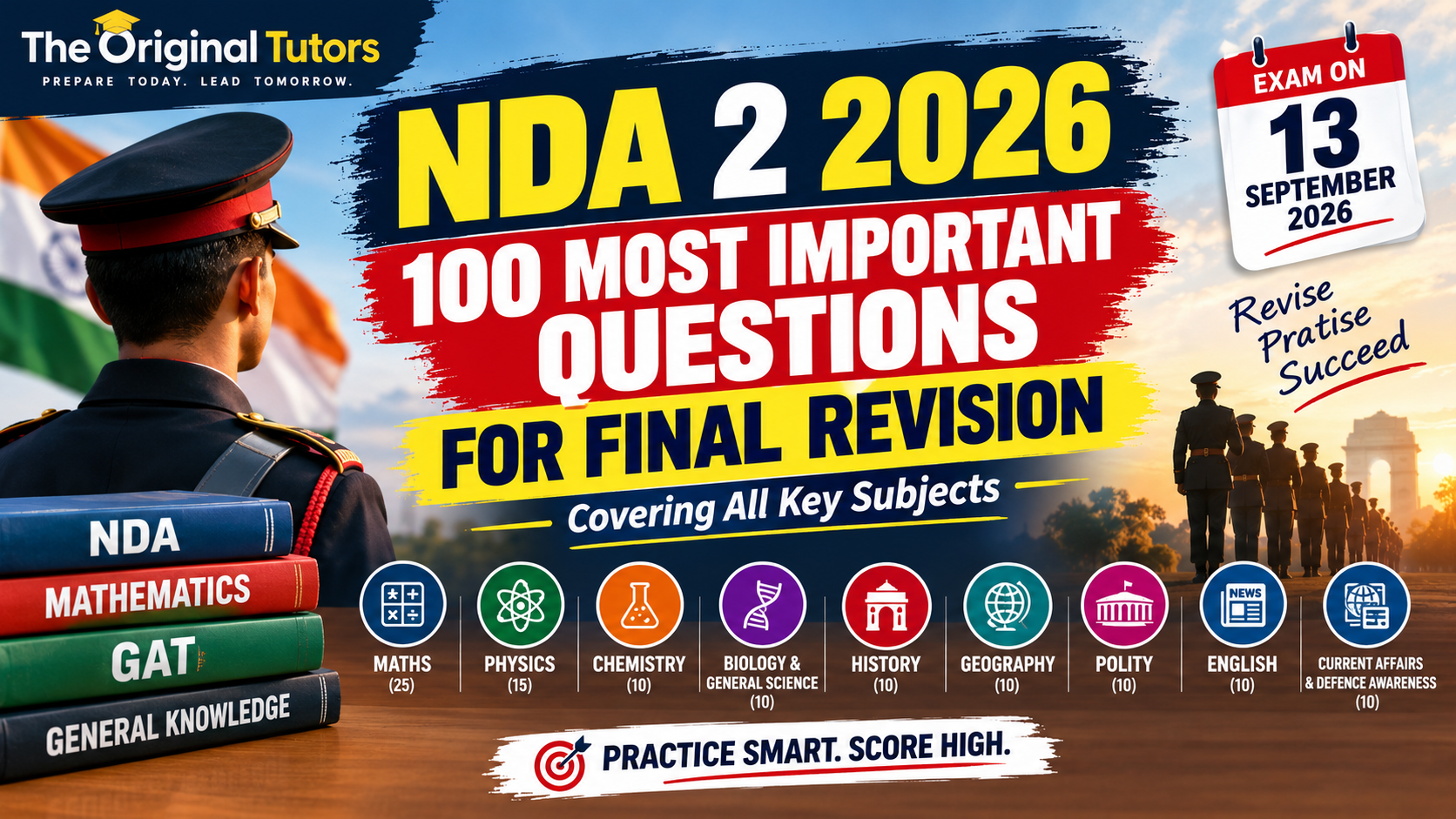
NDA 2 2026: 100 Most Important Questions for Final Revision Before the 13 September Exam
NDA 2 2026 is just around the corner. With the examination scheduled for 13 September 2026, the final days should be used for smart revision rather than trying to complete the entire syllabus again.
This special revision set from The Original Tutors contains 100 important NDA-level questions covering Mathematics, Physics, Chemistry, Biology, History, Geography, Polity, General Science, English and recent current affairs.
These are not claims about the questions that will appear in the actual NDA 2 2026 paper. Instead, they are designed to help aspirants revise important concepts and frequently tested areas before the examination.
Last 7 Days Rule: Revise → Practise → Analyse → Repeat.
NDA 2 2026 Final Revision: 100 Important Questions
SECTION A — MATHEMATICS
Questions 1–25
1. If A = {1, 2, 3} and B = {2, 3, 4}, what is A ∩ B?
A. {1, 4}
B. {2, 3}
C. {1, 2, 3, 4}
D. {3, 4}
Answer: B — {2, 3}
2. If the roots of x² − 5x + 6 = 0 are α and β, what is α + β?
A. 5
B. 6
C. −5
D. −6
Answer: A — 5
3. What is the value of sin²θ + cos²θ?
A. 0
B. 1
C. 2
D. sin θ
Answer: B — 1
4. If tan θ = 1, where θ is an acute angle, then θ is:
A. 30°
B. 45°
C. 60°
D. 90°
Answer: B — 45°
5. What is the determinant of the matrix [[2, 3], [1, 4]]?
A. 5
B. 8
C. 11
D. 6
Answer: A — 5
6. The sum of the first n natural numbers is:
A. n²
B. n(n + 1)/2
C. n(n − 1)/2
D. 2n
Answer: B
7. The number of ways of selecting 2 objects from 5 objects is:
A. 5
B. 10
C. 15
D. 20
Answer: B — 10
8. What is the probability of getting a head when a fair coin is tossed once?
A. 0
B. 1
C. 1/2
D. 1/4
Answer: C — 1/2
9. The slope of a line parallel to the x-axis is:
A. 1
B. −1
C. 0
D. Undefined
Answer: C — 0
10. The distance between the points (0,0) and (3,4) is:
A. 3
B. 4
C. 5
D. 7
Answer: C — 5
11. The derivative of x² with respect to x is:
A. x
B. 2x
C. x²
D. 2
Answer: B — 2x
12. The derivative of sin x is:
A. −sin x
B. cos x
C. −cos x
D. tan x
Answer: B — cos x
13. ∫2x dx is equal to:
A. x² + C
B. 2x² + C
C. x + C
D. 2 + C
Answer: A — x² + C
14. The mean of 2, 4, 6, 8 and 10 is:
A. 5
B. 6
C. 7
D. 8
Answer: B — 6
15. The volume of a cylinder of radius r and height h is:
A. πrh
B. 2πrh
C. πr²h
D. 2πr²h
Answer: C — πr²h
16. If two vectors are perpendicular, their dot product is:
A. 1
B. −1
C. 0
D. Infinity
Answer: C — 0
17. If log₁₀100 = x, then x equals:
A. 1
B. 2
C. 10
D. 100
Answer: B — 2
18. The roots of x² − 9 = 0 are:
A. 3 only
B. −3 only
C. ±3
D. 9 and −9
Answer: C — ±3
19. If a:b = 2:3 and b:c = 3:4, then a:c is:
A. 1:2
B. 2:4
C. 2:3
D. 3:4
Answer: B — 1:2
20. What is the value of 5! ?
A. 20
B. 60
C. 100
D. 120
Answer: D — 120
21. The equation of the x-axis is:
A. x = 0
B. y = 0
C. x = y
D. x + y = 0
Answer: B — y = 0
22. The probability of an impossible event is:
A. 0
B. 1
C. −1
D. 1/2
Answer: A — 0
23. If a matrix has equal number of rows and columns, it is called a:
A. Row matrix
B. Column matrix
C. Square matrix
D. Null matrix
Answer: C — Square matrix
24. The sum of angles of a triangle is:
A. 90°
B. 180°
C. 270°
D. 360°
Answer: B — 180°
25. If the radius of a circle is doubled, its area becomes:
A. 2 times
B. 3 times
C. 4 times
D. 8 times
Answer: C — 4 times
SECTION B — PHYSICS
Questions 26–40
26. What is the SI unit of force?
A. Joule
B. Newton
C. Watt
D. Pascal
Answer: B — Newton
27. Newton's first law is also known as the law of:
A. Gravitation
B. Acceleration
C. Inertia
D. Momentum
Answer: C — Inertia
28. The SI unit of work is:
A. Watt
B. Newton
C. Joule
D. Pascal
Answer: C — Joule
29. The acceleration due to gravity near the Earth's surface is approximately:
A. 4.9 m/s²
B. 9.8 m/s²
C. 19.6 m/s²
D. 98 m/s²
Answer: B — 9.8 m/s²
30. Which quantity is measured in watts?
A. Energy
B. Force
C. Power
D. Momentum
Answer: C — Power
31. The speed of light is maximum in:
A. Water
B. Glass
C. Vacuum
D. Diamond
Answer: C — Vacuum
32. Which lens is generally used to correct myopia?
A. Convex lens
B. Concave lens
C. Cylindrical lens only
D. Plane glass
Answer: B — Concave lens
33. The SI unit of electric current is:
A. Volt
B. Ohm
C. Ampere
D. Coulomb
Answer: C — Ampere
34. Ohm's law is represented by:
A. V = IR
B. P = VI
C. F = ma
D. W = Fs
Answer: A — V = IR
35. Which instrument measures electric current?
A. Voltmeter
B. Ammeter
C. Barometer
D. Hygrometer
Answer: B — Ammeter
36. Sound cannot travel through:
A. Solids
B. Liquids
C. Gases
D. Vacuum
Answer: D — Vacuum
37. Which form of energy is stored in a stretched spring?
A. Nuclear energy
B. Elastic potential energy
C. Chemical energy
D. Sound energy
Answer: B — Elastic potential energy
38. Which phenomenon explains the formation of a rainbow?
A. Reflection only
B. Dispersion of light
C. Magnetism
D. Conduction
Answer: B — Dispersion of light
39. A transformer works on the principle of:
A. Electromagnetic induction
B. Electrolysis
C. Thermal expansion
D. Photoelectric effect
Answer: A — Electromagnetic induction
40. Which particle has a negative electric charge?
A. Proton
B. Neutron
C. Electron
D. Nucleus
Answer: C — Electron
SECTION C — CHEMISTRY
Questions 41–50
41. What is the atomic number of hydrogen?
A. 0
B. 1
C. 2
D. 8
Answer: B — 1
42. The pH of a neutral solution at 25°C is approximately:
A. 0
B. 5
C. 7
D. 14
Answer: C — 7
43. Which gas is essential for respiration?
A. Nitrogen
B. Oxygen
C. Carbon dioxide
D. Hydrogen
Answer: B — Oxygen
44. The chemical formula of water is:
A. CO₂
B. H₂O
C. O₂
D. H₂
Answer: B — H₂O
45. Which metal is liquid at room temperature?
A. Iron
B. Copper
C. Mercury
D. Aluminium
Answer: C — Mercury
46. Rusting of iron requires oxygen and:
A. Nitrogen
B. Moisture
C. Hydrogen
D. Carbon monoxide
Answer: B — Moisture
47. The gas used by green plants during photosynthesis is:
A. Oxygen
B. Nitrogen
C. Carbon dioxide
D. Hydrogen
Answer: C — Carbon dioxide
48. Which of the following is an acid?
A. NaOH
B. HCl
C. NaCl
D. CaO
Answer: B — HCl
49. The hardest naturally occurring substance is:
A. Iron
B. Graphite
C. Diamond
D. Quartz
Answer: C — Diamond
50. The periodic table is arranged primarily according to:
A. Atomic mass
B. Atomic number
C. Density
D. Melting point
Answer: B — Atomic number
SECTION D — BIOLOGY & GENERAL SCIENCE
Questions 51–60
51. The basic structural and functional unit of life is:
A. Tissue
B. Organ
C. Cell
D. Nucleus
Answer: C — Cell
52. Which organ pumps blood throughout the human body?
A. Liver
B. Kidney
C. Heart
D. Lung
Answer: C — Heart
53. Which blood cells are primarily responsible for fighting infections?
A. Red blood cells
B. White blood cells
C. Platelets
D. Plasma cells only
Answer: B — White blood cells
54. Which organ is primarily responsible for filtering blood and forming urine?
A. Heart
B. Kidney
C. Stomach
D. Pancreas
Answer: B — Kidney
55. Photosynthesis mainly takes place in the:
A. Nucleus
B. Chloroplast
C. Mitochondria
D. Ribosome
Answer: B — Chloroplast
56. Which vitamin is produced in the skin in the presence of sunlight?
A. Vitamin A
B. Vitamin B12
C. Vitamin C
D. Vitamin D
Answer: D — Vitamin D
57. The largest organ of the human body is:
A. Liver
B. Brain
C. Skin
D. Lung
Answer: C — Skin
58. Which hormone regulates blood sugar levels?
A. Insulin
B. Thyroxine
C. Adrenaline
D. Estrogen
Answer: A — Insulin
59. Which part of the plant mainly absorbs water and minerals from the soil?
A. Leaf
B. Stem
C. Root
D. Flower
Answer: C — Root
60. Malaria is caused by a:
A. Virus
B. Bacterium
C. Protozoan
D. Fungus
Answer: C — Protozoan
SECTION E — HISTORY
Questions 61–70
61. Who founded the Mauryan Empire?
A. Ashoka
B. Chandragupta Maurya
C. Harshavardhana
D. Samudragupta
Answer: B — Chandragupta Maurya
62. Ashoka belonged to which dynasty?
A. Gupta
B. Maurya
C. Chola
D. Mughal
Answer: B — Maurya
63. Who wrote the Arthashastra?
A. Kalidasa
B. Kautilya
C. Banabhatta
D. Megasthenes
Answer: B — Kautilya
64. The Battle of Plassey was fought in:
A. 1757
B. 1764
C. 1857
D. 1947
Answer: A — 1757
65. The Revolt of 1857 began at:
A. Delhi
B. Meerut
C. Kanpur
D. Lucknow
Answer: B — Meerut
66. Who founded the Indian National Congress in 1885 along with other early leaders?
A. A.O. Hume
B. Lord Curzon
C. Lord Mountbatten
D. Warren Hastings
Answer: A — A.O. Hume
67. The Non-Cooperation Movement was launched under the leadership of:
A. Subhas Chandra Bose
B. Mahatma Gandhi
C. Jawaharlal Nehru
D. Sardar Patel
Answer: B — Mahatma Gandhi
68. The Dandi March was associated with the:
A. Quit India Movement
B. Civil Disobedience Movement
C. Non-Cooperation Movement
D. Swadeshi Movement
Answer: B — Civil Disobedience Movement
69. The Quit India Movement was launched in:
A. 1919
B. 1930
C. 1942
D. 1947
Answer: C — 1942
70. Who gave the slogan “Give me blood and I will give you freedom”?
A. Bhagat Singh
B. Subhas Chandra Bose
C. Mahatma Gandhi
D. Bal Gangadhar Tilak
Answer: B — Subhas Chandra Bose
SECTION F — GEOGRAPHY
Questions 71–80
71. Which is the longest river in India?
A. Yamuna
B. Godavari
C. Ganga
D. Narmada
Answer: C — Ganga
72. Which river is known as the “Sorrow of Bihar”?
A. Kosi
B. Narmada
C. Tapi
D. Krishna
Answer: A — Kosi
73. The Tropic of Cancer passes through how many Indian states?
A. 6
B. 7
C. 8
D. 9
Answer: C — 8
74. Which soil is particularly suitable for cotton cultivation?
A. Alluvial soil
B. Black soil
C. Laterite soil
D. Mountain soil
Answer: B — Black soil
75. The Western Ghats are also known as:
A. Sahyadri
B. Shivalik
C. Aravalli
D. Nilgiri
Answer: A — Sahyadri
76. Which is the largest ocean in the world?
A. Atlantic Ocean
B. Indian Ocean
C. Pacific Ocean
D. Arctic Ocean
Answer: C — Pacific Ocean
77. Which Indian state has the longest coastline?
A. Kerala
B. Gujarat
C. Tamil Nadu
D. Andhra Pradesh
Answer: B — Gujarat
78. The Sundarbans are primarily associated with:
A. Tropical thorn forests
B. Mangrove forests
C. Alpine forests
D. Coniferous forests
Answer: B — Mangrove forests
79. Which monsoon is primarily responsible for most of India's rainfall?
A. Northeast monsoon
B. Southwest monsoon
C. Northwesterly winds
D. Westerlies
Answer: B — Southwest monsoon
80. The Narmada River flows mainly towards the:
A. East
B. West
C. North
D. South
Answer: B — West
SECTION G — INDIAN POLITY
Questions 81–90
81. The Constitution of India came into force on:
A. 15 August 1947
B. 26 November 1949
C. 26 January 1950
D. 2 October 1950
Answer: C — 26 January 1950
82. The Constitution of India was adopted on:
A. 15 August 1947
B. 26 November 1949
C. 26 January 1950
D. 9 December 1946
Answer: B — 26 November 1949
83. Fundamental Rights are contained in which part of the Constitution?
A. Part I
B. Part II
C. Part III
D. Part IV
Answer: C — Part III
84. The President of India is elected by:
A. Direct vote of citizens
B. Electoral College
C. Lok Sabha alone
D. Rajya Sabha alone
Answer: B — Electoral College
85. The Council of Ministers is collectively responsible to the:
A. President
B. Rajya Sabha
C. Lok Sabha
D. Supreme Court
Answer: C — Lok Sabha
86. The highest court of India is the:
A. High Court
B. Supreme Court
C. District Court
D. Constitutional Tribunal
Answer: B — Supreme Court
87. The constitutional head of the Union is the:
A. Prime Minister
B. President
C. Chief Justice
D. Speaker
Answer: B — President
88. The minimum voting age in India is:
A. 16
B. 18
C. 21
D. 25
Answer: B — 18
89. Directive Principles of State Policy are contained in:
A. Part III
B. Part IV
C. Part V
D. Part VI
Answer: B — Part IV
90. The Indian Parliament consists of the President and:
A. Lok Sabha only
B. Rajya Sabha only
C. Lok Sabha and Rajya Sabha
D. Supreme Court
Answer: C — Lok Sabha and Rajya Sabha
SECTION H — ENGLISH
Questions 91–95
91. Choose the correct synonym of “ABANDON”:
A. Continue
B. Leave
C. Collect
D. Protect
Answer: B — Leave
92. Choose the antonym of “ANCIENT”:
A. Old
B. Historic
C. Modern
D. Traditional
Answer: C — Modern
93. Choose the correct preposition:
“He is good ___ Mathematics.”
A. in
B. at
C. on
D. with
Answer: B — at
94. Choose the correctly spelt word:
A. Accomodation
B. Acommodation
C. Accommodation
D. Accommadation
Answer: C — Accommodation
95. Identify the correct sentence:
A. He do not know the answer.
B. He does not knows the answer.
C. He does not know the answer.
D. He did not knew the answer.
Answer: C — He does not know the answer.
SECTION I — CURRENT AFFAIRS & DEFENCE AWARENESS
Questions 96–100
96. Who is the current President of India?
A. Pratibha Patil
B. Droupadi Murmu
C. Ram Nath Kovind
D. Nirmala Sitharaman
Answer: B — Droupadi Murmu
The official President of India website identifies Smt. Droupadi Murmu as the 15th President of India, sworn in on 25 July 2022.
97. Which Indian organisation successfully launched the GSLV-F17/EOS-05 mission on 4 September 2026?
A. DRDO
B. ISRO
C. HAL
D. BARC
Answer: B — ISRO
ISRO lists the GSLV-F17/EOS-05 mission with a launch date of 4 September 2026.
98. What was the theme of the 3rd National Space Day 2026?
A. Space for Humanity
B. Towards Viksit Bharat: Innovating, Collaborating and Aspiring to Global Space Leadership
C. Digital India Through Space
D. Space Technology for Defence
Answer: B
ISRO states that the 3rd National Space Day 2026 was held at Ahmedabad and gives this year's theme as “Towards Viksit Bharat: Innovating, Collaborating and Aspiring to Global Space Leadership.”
99. Which team won the ICC Men's T20 World Cup 2026?
A. Australia
B. England
C. India
D. New Zealand
Answer: C — India
India defeated New Zealand by 96 runs in the final in Ahmedabad and became the first men's team to win the T20 World Cup in consecutive editions.
100. The 2026 Winter Olympics were held in which location?
A. Paris
B. Milano Cortina
C. Tokyo
D. Los Angeles
Answer: B — Milano Cortina
The 2026 Winter Olympics were held in Milano Cortina, Italy.
How to Use These 100 Questions Before NDA 2 2026
Do not simply read the answers.
Use this three-step method:
Round 1 — Test Yourself
Cover the answers and attempt all 100 questions.
Mark each question:
🟢 I know it
🟡 I was unsure
🔴 I got it wrong
Round 2 — Revise Your Weak Areas
Your red and yellow questions are more important than the questions you already know.
Revise the related concept immediately.
Round 3 — Take a Timed Mock Test
After completing this revision set, attempt a full-length NDA mock test.
Then analyse:
- Accuracy
- Time management
- Questions left unattempted
- Silly mistakes
- Weak chapters
- Guessing errors
Important: Don't Treat These as Predicted Questions
The purpose of this article is final revision, not prediction.
No coaching institute can legitimately guarantee the exact questions that UPSC will ask.
The best strategy is to combine:
Official syllabus + Previous-Year Papers + Concept Revision + Mock Tests + Current Affairs
UPSC publishes official previous-year NDA question papers, including Mathematics and General Ability Test papers, which should be used alongside any revision material.
NDA 2 2026: Your Final 7-Day Strategy
If you have only a few days remaining, follow this sequence:
Day 1
Mathematics + Physics
Day 2
History + Geography
Day 3
Chemistry + Biology + General Science
Day 4
English + Mathematics
Day 5
Current Affairs + Defence Awareness + GK
Day 6
Full Mock Test + Detailed Analysis
Day 7
Formula revision + short notes + light revision
And remember:
Do not try to become a new student in the final seven days. Become a more accurate version of the student you already are.
Final Words from The Original Tutors
The NDA examination is not just a test of knowledge.
It tests your:
- Accuracy
- Speed
- Decision-making
- Discipline
- Time management
- Mental composure
You have prepared for this moment.
Now trust your preparation.
Revise smartly.
Practise seriously.
Avoid unnecessary mistakes.
And give your best on 13 September 2026.
Your Dream. Our Mission.
The Original Tutors
Prepare Today. Lead Tomorrow.
Jai Hind! 🇮🇳
Frequently Asked Questions
When is NDA 2 2026?
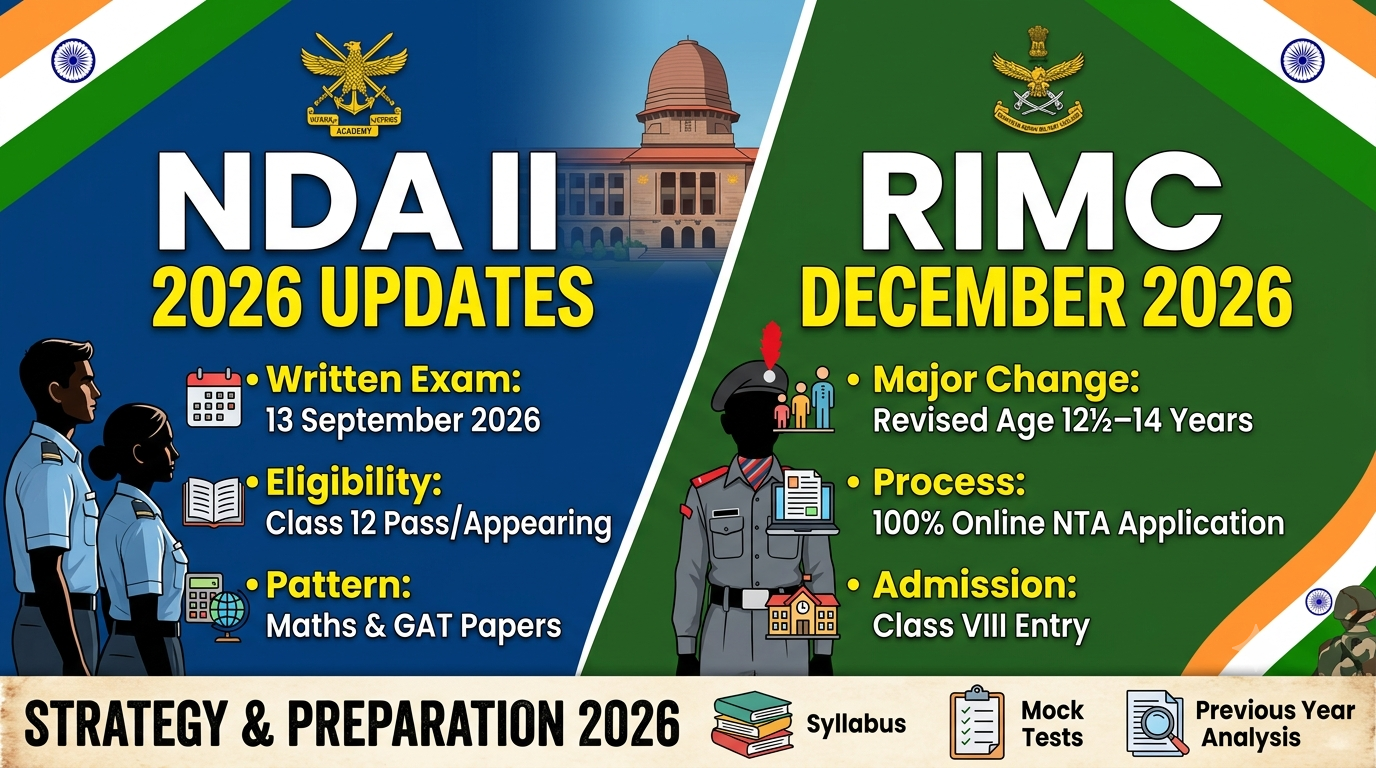
The UPSC National Defence Academy and Naval Academy Examination (II), 2026 is scheduled for 13 September 2026.
What should I revise before NDA 2 2026?
Focus on Mathematics, English, Physics, Chemistry, General Science, History, Geography, Polity and current affairs. Give particular attention to your weak areas and previous-year questions.
Are these NDA 2 2026 expected questions?
No. These are important final-revision questions, not guaranteed or leaked questions.
How should I prepare in the last week?
Prioritise revision, previous-year questions, mock tests and analysis of mistakes rather than starting large new topics.
Where can I find official NDA previous-year papers?
UPSC publishes previous-year question papers on its official website, including NDA Mathematics and General Ability Test papers.
Is current affairs important for NDA?
Yes. Current affairs should form part of your final revision, particularly national and international developments, defence, science and technology, sports and major government-related developments.
Disclaimer: This article is prepared for educational and revision purposes. The questions are selected as practice/revision questions and should not be treated as predictions of the actual UPSC NDA 2 2026 question paper.