Latest NDA & RIMC Exam Updates 2026: Dates, Eligibility, Pattern & Preparation Strategy
For thousands of school students across India, the NDA and RIMC examinations are among the most exciting pathways toward a disciplined, academically strong career connected with the armed forces. But success in these examinations requires much more than last-minute preparation.
As of August 2026, there are some important developments that students and parents should know—particularly regarding NDA II 2026 and the RIMC December 2026 examination cycle.
NDA II 2026: Important Dates
The Union Public Service Commission (UPSC) has officially scheduled the National Defence Academy and Naval Academy Examination (II), 2026 for:
- Notification: 20 May 2026
- Last date to apply: 11 June 2026
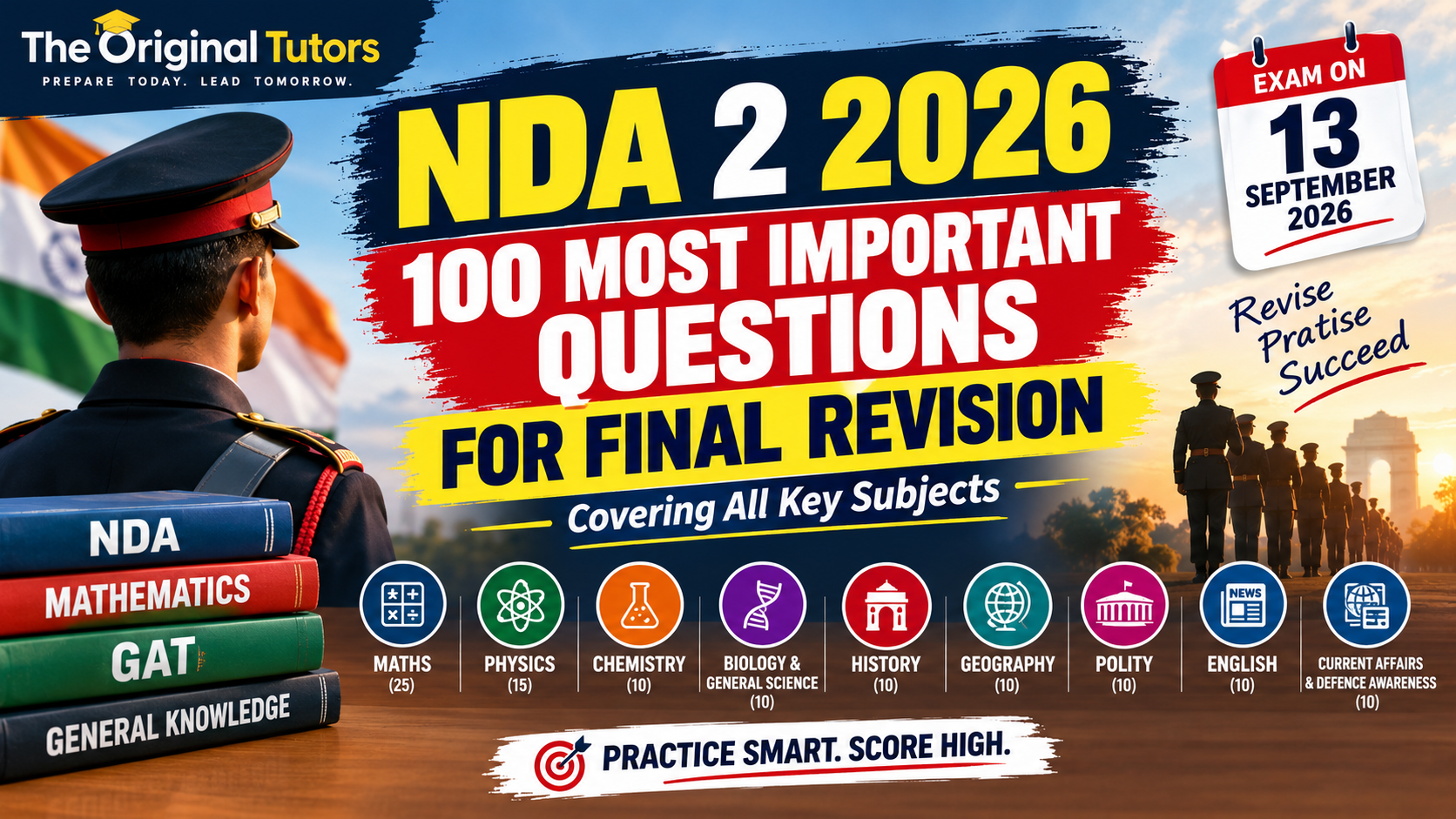
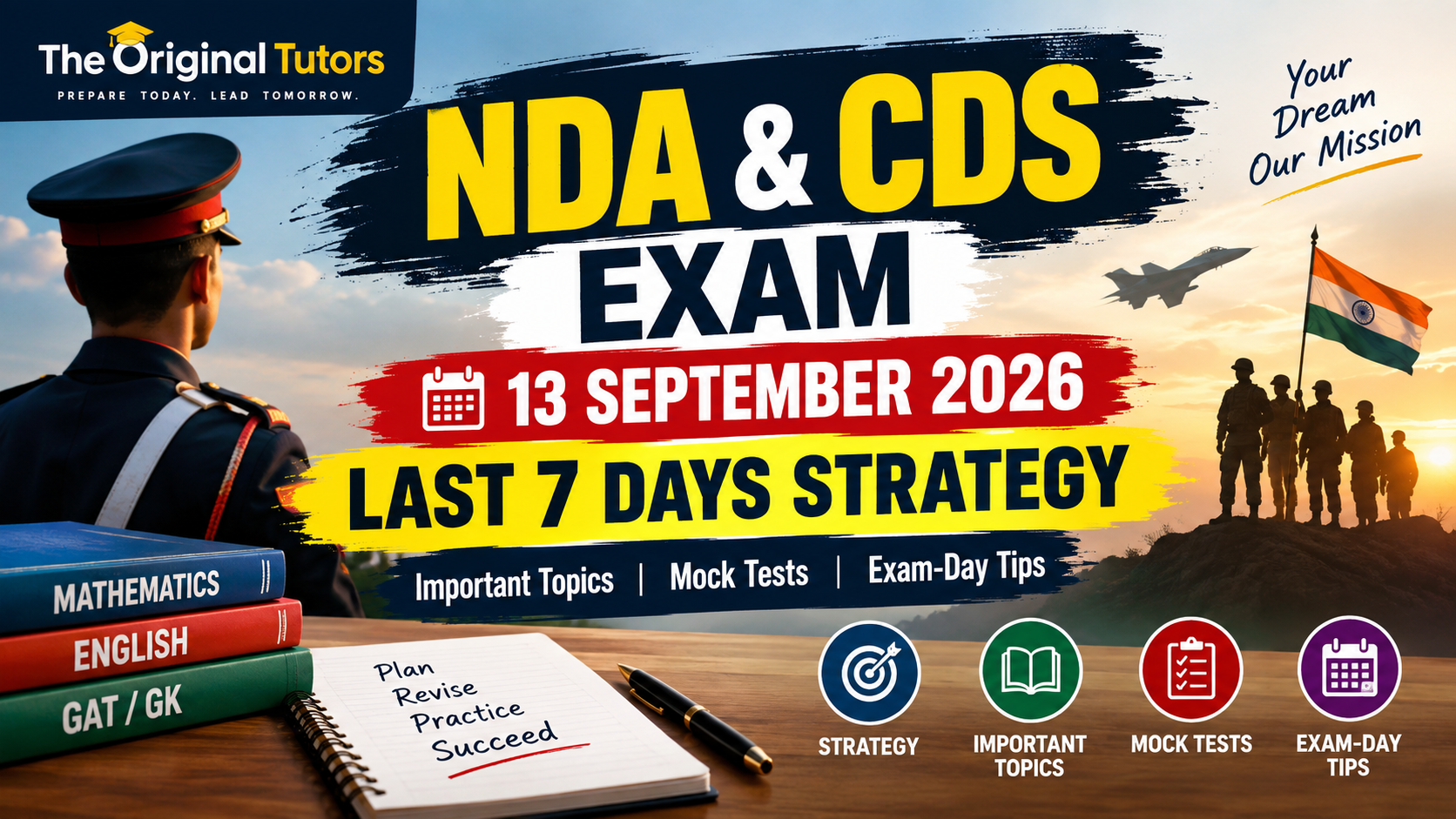
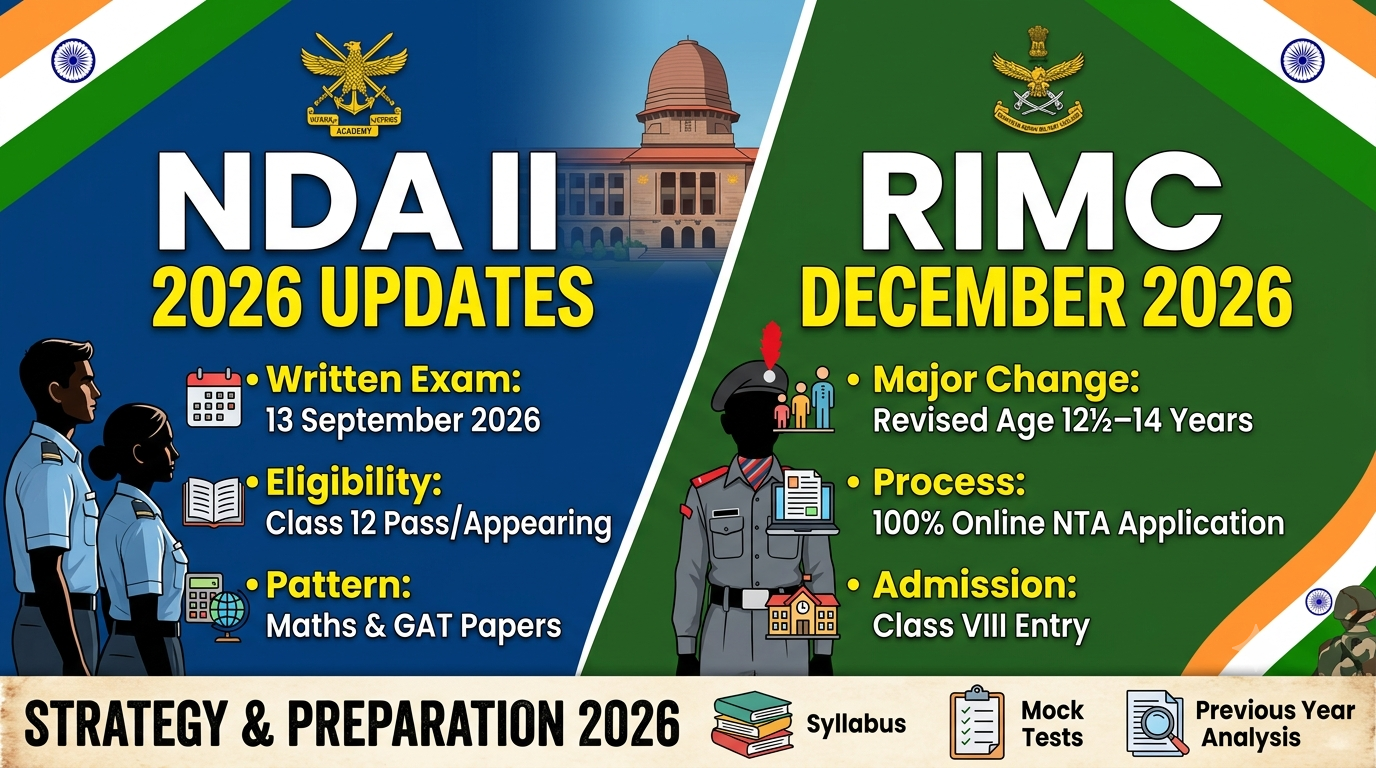
- NDA II 2026 written examination: 13 September 2026
- Duration: One day
These dates are officially listed by UPSC.
For students targeting NDA II 2026, the message is simple: the examination is now very close, so preparation must move from learning mode to revision, testing and performance mode.
NDA Eligibility: Who Can Apply?
NDA eligibility depends on age, marital status, nationality and educational qualification prescribed in the UPSC notification.
The broad educational requirement is:
- Army Wing: Class 12 pass or appearing under the 10+2 pattern.
- Air Force and Naval Wings: Class 12 with Physics, Chemistry and Mathematics (PCM) or equivalent.
- Candidates appearing in Class 12 can also apply, subject to fulfilling the prescribed conditions.
- Candidates must satisfy the specific age/date-of-birth conditions mentioned in the examination notification.
- NDA is open to eligible male and female candidates.
The educational requirements for Army and the Air Force/Naval wings are specified separately in the UPSC examination rules.
Important: Age eligibility is determined by the exact date-of-birth window in the relevant UPSC notification. Students should never rely on an approximate age calculation.
NDA Exam Pattern
The NDA written examination consists of two papers:
1. Mathematics
- Maximum Marks: 300
- Objective-type questions
- Major areas include Algebra, Trigonometry, Geometry, Mensuration, Calculus, Statistics and related mathematical concepts.
2. General Ability Test (GAT)
- Maximum Marks: 600
- English
- General Knowledge
- Physics
- Chemistry
- General Science
- History
- Geography
- Current Events
The written examination is followed by the Services Selection Board (SSB) process for candidates who qualify the written stage.
The selection process therefore requires preparation for both academic performance and officer-like qualities. UPSC's examination rules provide for written examination followed by SSB assessment and, where applicable, the prescribed additional requirements for Air Force candidates.
The Biggest NDA Preparation Mistake
Many students make the mistake of thinking:
"I will first complete the syllabus and then start solving papers."
That approach is risky.
A better strategy is:
Learn → Practise → Test → Analyse → Revise → Retest
Every mock test should answer three questions:
- Which questions did I get wrong?
- Why did I get them wrong?
- How will I prevent the same mistake next time?
For NDA, accuracy and time management are as important as knowledge.
RIMC 2026: A Major Update Students Must Know
RIMC has announced an important change beginning with the December 2026 examination cycle, which is for admission to the July 2027 term.
This is one of the most significant recent RIMC updates.
According to the official RIMC notice:
Age eligibility is being revised
Earlier age criterion:
- 11½ to 13 years
Revised age criterion from the December 2026 examination cycle:
- 12½ to 14 years
This change is specifically applicable from the December 2026 examination cycle.
Application process is becoming completely online
From the December 2026 cycle:
- Registration will be through the National Testing Agency (NTA) portal.
- Candidates will complete the application online.
- Prescribed documents will be uploaded online.
- No hard copy of the application form will be required.
- The written examination will be conducted at designated NTA examination centres across India.
RIMC has stated that the NTA registration link for this cycle will be made available when the process opens.
Parents and students should therefore be particularly careful about relying on old RIMC application procedures. The December 2026 cycle introduces a new system.
RIMC December 2026 Examination: What We Know
The official RIMC announcement confirms that the December 2026 examination is for admission to the July 2027 term. However, as of the latest official notice, the detailed examination schedule/registration URL is still to be published.
Students should therefore avoid treating unofficial dates circulating on coaching websites or social media as confirmed dates.
Always verify the final schedule on the official RIMC/NTA notification.
RIMC Eligibility and Admission
RIMC admissions are made to Class VIII. The candidate must be studying in Class VII or have passed Class VII from a recognised school at the time of joining.
The RIMC selection process traditionally includes:
- Written examination
- Viva-voce/interview
- Medical fitness assessment
The official RIMC website continues to describe these components of the admission process.
The December 2026 cycle introduces the revised age criterion and online NTA registration system, so candidates should wait for the detailed notification for the exact date-of-birth window and other conditions.
What About the June 2026 RIMC Examination?
The June 2026 RIMC examination was conducted for admission to the January 2027 term.
The written examination was held on 7 June 2026, and the examination consisted of:
- Mathematics
- General Knowledge
- English
The official RIMC website has subsequently published the written results for boys and girls for this examination, with the latest results listed on 19 August 2026.
This is particularly important for students preparing for the next RIMC cycle because the previous examination provides a useful reference point for understanding the standard and nature of preparation required.
NDA vs RIMC: Which Preparation Strategy Is Better?
Although NDA and RIMC are different examinations, students can build several common skills.
| AreaNDARIMC | ||
| Mathematics | Very important | Very important |
| English | Important | Important |
| General Knowledge | Important | Important |
| Current Affairs | Important | Useful |
| Speed & Accuracy | Essential | Essential |
| Written Practice | Essential | Essential |
| Interview/Viva | SSB after written | Viva after written |
| Long-term Foundation | Extremely valuable | Extremely valuable |
The biggest difference is the level and age group.
An RIMC aspirant is preparing for entry into Class VIII, whereas an NDA aspirant is preparing for entry into the National Defence Academy after/while completing Class XII.
How Should Students Prepare for NDA II 2026?
With the examination scheduled for 13 September 2026, the remaining preparation should be highly focused.
1. Stop collecting resources
Do not keep changing books, teachers or study material.
Choose:
- One reliable Mathematics source
- One English source
- One General Studies/GK source
- Previous-year question papers
- A quality mock-test series
- A current-affairs source
Then revise them repeatedly.
2. Solve Previous-Year Questions
Previous-year questions reveal:
- Frequently tested concepts
- Difficulty level
- Question framing
- Time pressure
- Important chapters
A student who studies concepts without solving previous papers is leaving a major part of NDA preparation incomplete.
3. Take Full-Length Mock Tests
A practical approach is:
- Start with one diagnostic test.
- Identify weak areas.
- Practise those areas.
- Take regular full-length tests.
- Analyse every test.
Don't judge preparation only by the score.
The analysis after the test is often more valuable than the test itself.
4. Strengthen Mathematics
Give special attention to:
- Algebra
- Trigonometry
- Geometry
- Mensuration
- Calculus
- Statistics
- Probability
- Matrices and determinants
- Complex numbers
- Coordinate geometry
The exact distribution can vary, so students should prepare the complete prescribed syllabus rather than betting on a few chapters.
5. Build GAT Through Daily Study
GAT should not be left for the final weeks.
A daily routine can include:
- English vocabulary and grammar
- Reading comprehension
- Current affairs
- Science revision
- History
- Geography
- Defence-related awareness
How Should RIMC Aspirants Prepare?
RIMC preparation should begin with strong school-level fundamentals.
Mathematics
Focus on:
- Arithmetic
- Fractions and decimals
- Percentage
- Ratio and proportion
- Average
- Profit and loss
- Simple and compound interest
- Geometry
- Mensuration
- Algebra
- Data interpretation
But do not restrict preparation only to memorising formulas.
The student should develop the ability to solve unfamiliar problems quickly.
English
Build strength in:
- Grammar
- Vocabulary
- Synonyms and antonyms
- Comprehension
- Sentence formation
- Spelling
- Writing skills
Reading for 20–30 minutes every day can gradually improve vocabulary and comprehension.
General Knowledge
RIMC aspirants should develop awareness of:
- India
- Geography
- History
- Science
- Important personalities
- Awards
- Sports
- National and international events
- Current affairs
For younger students, GK preparation should be interesting rather than overwhelming.
What Expert Tutors Usually See in Successful Students
Experienced defence-exam teachers often notice a common pattern among successful candidates.
They are not necessarily the students who study for the longest hours.
They are usually the students who:
- Study consistently.
- Revise repeatedly.
- Solve questions every day.
- Learn from mistakes.
- Ask questions instead of hiding doubts.
- Take mock tests seriously.
- Maintain discipline.
- Avoid constantly changing study material.
- Begin preparation early.
One of the strongest advantages of early preparation is that students can build fundamentals without excessive pressure.
A Class 9 or 10 student targeting NDA, for example, can gradually strengthen Mathematics, English, Science, GK and reasoning ability alongside school studies rather than attempting to learn everything after Class 12.
Lessons from Successful Defence Aspirants
Success stories in competitive examinations often look dramatic when viewed only from the final result.
But behind a successful result there are usually months or years of:
- Regular classes
- Daily practice
- Mock tests
- Error analysis
- Revision
- Doubt clearing
- Discipline
The important lesson for parents is:
Don't ask only, "How many hours did you study today?"
Ask:
"What did you learn, what did you practise, and what mistakes did you correct today?"
That shift can make preparation much more productive.
A Practical Daily Routine
For a school student, preparation should remain balanced with regular school studies.
A sample routine could be:
- 45–60 minutes: Mathematics
- 30–45 minutes: English
- 30 minutes: GK/Current Affairs
- 30 minutes: Previous-year questions or practice set
- 15–20 minutes: Revision of mistakes
On weekends:
- One sectional test
- One full/combined mock test when appropriate
- Detailed test analysis
- Revision of weak topics
Consistency matters more than studying excessively for a few days and then taking a long break.
Resources Students Should Use
A strong preparation library should include:
- NCERT textbooks
- UPSC NDA syllabus and official notification
- Previous-year NDA question papers
- RIMC previous-year question papers
- Standard Mathematics practice material
- English grammar and vocabulary resources
- Reliable current-affairs notes
- Full-length mock tests
- Personal error notebook
For RIMC, previous-year papers are particularly useful for becoming familiar with the style of questions.
RIMC itself states that previous-year question-paper material can be purchased through its official arrangements.
Parents: How Can You Help?
Parents play an important role in a student's preparation.
Instead of creating constant pressure about marks:
- Create a fixed study environment.
- Encourage regular sleep.
- Reduce unnecessary distractions during study time.
- Monitor consistency rather than comparing the child with others.
- Encourage outdoor activity and healthy routines.
- Discuss mistakes constructively.
- Help the child maintain a realistic timetable.
Most importantly, don't turn every test score into a judgement about the student's ability.
A low mock-test score is feedback—not a final result.
Latest Updates at a Glance
NDA II 2026
- Exam: 13 September 2026
- Conducting body: UPSC
- Written papers: Mathematics + GAT
- Next major stage: SSB for written-qualified candidates
- Eligibility: Depends on prescribed age, educational and other UPSC conditions
- Application: The 2026 application window has already closed.
RIMC December 2026
- Admission term: July 2027
- Important change: Age criterion revised from 11½–13 years to 12½–14 years
- Application: Completely online through NTA
- Hard-copy application: Not required
- Exam centres: Designated NTA centres across India
- Detailed schedule: Await official notification
- Official advice: Follow RIMC/NTA announcements rather than unofficial dates.
Final Advice: Start Before You Feel Ready
Whether your target is NDA or RIMC, preparation should not begin with fear.
It should begin with a plan.
You don't need to become perfect in the first month.
You need to become better every month.
For NDA aspirants, the immediate priority is revision, previous-year questions, mock tests and performance analysis.
For students targeting the RIMC December 2026 cycle, the newly announced changes make it especially important to watch the official notification and prepare well in advance.
And for younger students who ultimately dream of NDA, foundation preparation is the real advantage.
Build Mathematics today.
Improve English today.
Read about India and the world today.
Develop discipline today.
The examination may come later—but the preparation for becoming a successful candidate starts much earlier.
Dream of the uniform. Prepare for the examination. Build the discipline. And let your daily consistency take you closer to the goal.
For official updates, students should regularly check the UPSC website and RIMC official website rather than relying on forwarded messages or social-media posts.